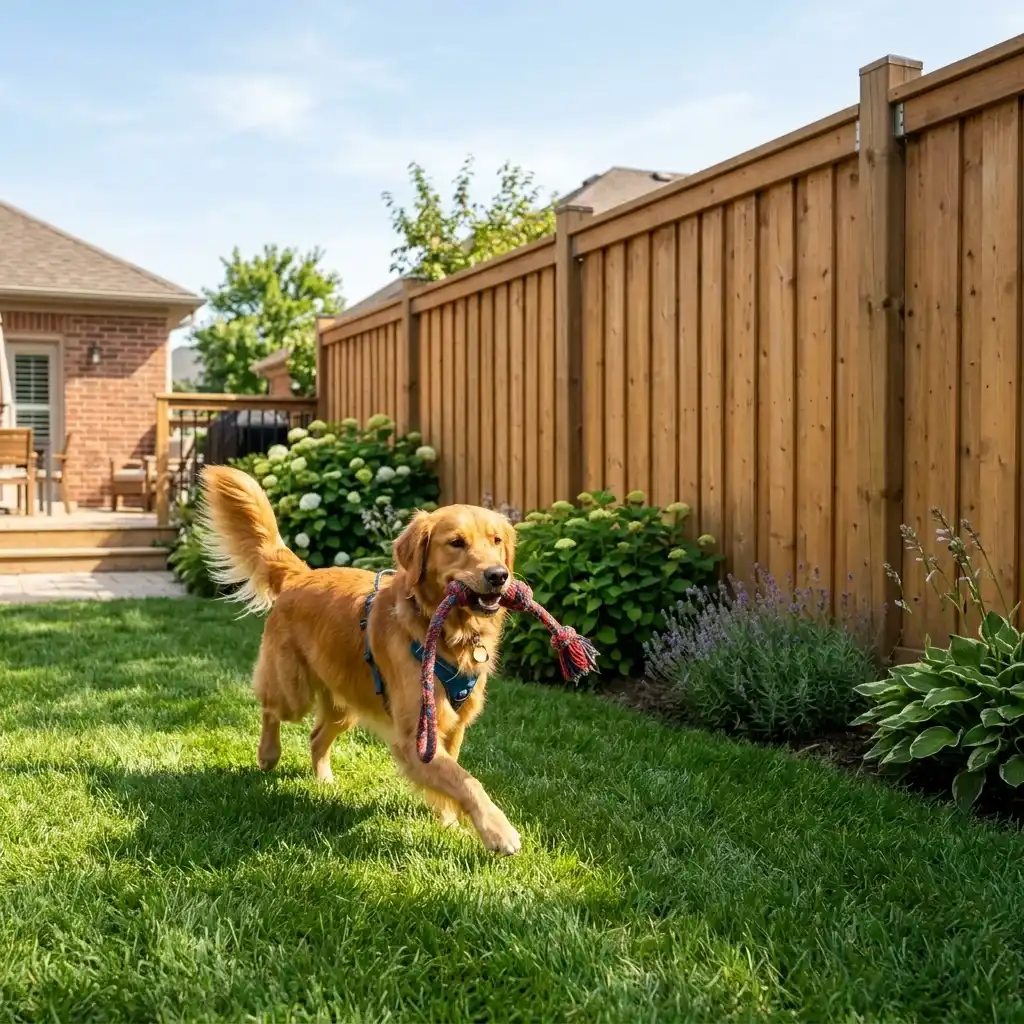
You let them out. You turn around to pour coffee. You look back - the yard is empty.
Dogs don't need a massive hole in the fence. They need one loose board, one weak gate latch, or one pile of firewood stacked too close to the edge.
Most escapes happen because of small, entirely fixable issues. Here's how to find and fix them before your dog does.
Step 1: Inspect Your Fence Height
Your fence is only as secure as your dog's ability to clear it.
| Dog Size / Drive | Minimum Height |
|---|---|
| Small | 4 feet |
| Medium | 5-6 feet |
| Large / Athletic | 6+ feet with anti-jump rollers |
If your dog can jump it, you don't have a secure perimeter. Add height extensions or anti-jump rollers to the top.
Step 2: Fix Gaps and Weak Points
Walk your entire fence line. Check every board, every month. Focus on:
- The bottom of the fence line where soil has eroded
- Hidden corners obscured by bushes
- Warped or decaying wood panels
- Gaps around gate hinges
Even a tiny gap can become a full escape route under stress or excitement.
Step 3: Stop Digging Escapes
Some dogs don't go over - they go under. Reinforce the base:
- Bury heavy-gauge wire mesh along the fence base
- Place heavy decorative rocks or landscaping boulders
- Reinforce with deep gravel along the soil line
Focus reinforcements where your dog already paces or sniffs - those are the spots they'll target.
Step 4: Remove Climbing Aids
Dogs use whatever you leave available. Remove:
- Patio furniture pushed against the fence
- Storage boxes or debris piles
- Stacked firewood or landscaping supplies
Anything near the fence line is a launch pad.
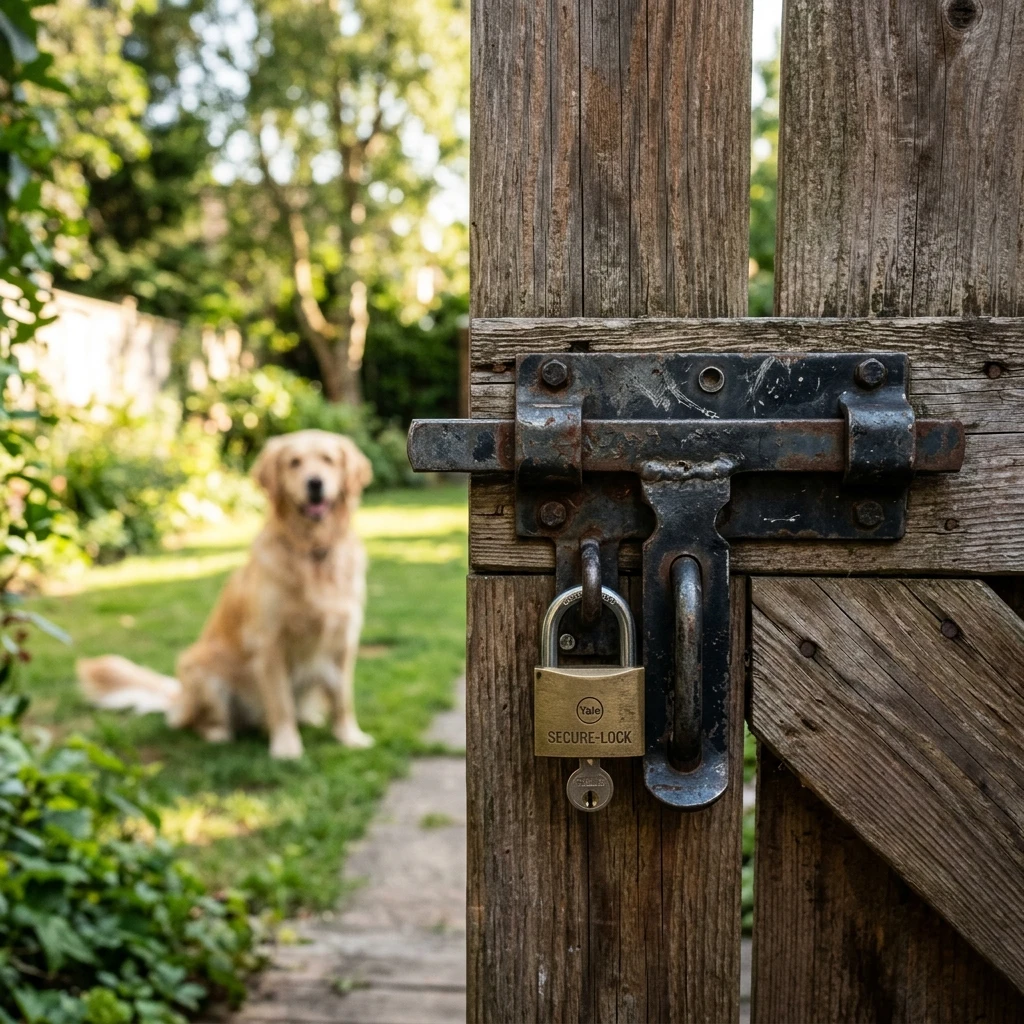
Step 5: Secure Your Gates (The #1 Escape Point)
The overwhelming majority of yard escapes happen at the gate. A service worker leaves it unlocked. A gust of wind pushes it open. Your dog jumps the latch.
Upgrade your gate hardware:
- Install commercial-grade, self-closing spring hinges
- Use dual-locking carabiner latches
- Eliminate gaps underneath the gate door
One open gate instantly undoes a perfect fence.
Step 6: Eliminate Visual Triggers
Dogs react powerfully to what they see. If they spot a squirrel, stranger, or another dog, their drive to pursue can override training instantly.
- Convert chainlink to solid privacy fencing
- Apply opaque privacy fabric to transparent barriers
- Redirect attention back into the yard
Less visual stimulation means less temptation to bolt.
Step 7: Supervise High-Risk Dogs
Some dogs will always try to beat the system: high-energy working breeds, intensely anxious dogs, young untrained rescues. These dogs cannot be left outside alone. They require active, 100% human supervision.
The Reality: No Physical System Is Perfect
Even a military-grade yard can fail. Somebody forgets to lock the gate. A storm knocks down a branch. Something unpredictable happens.
That's why physical prevention needs a backup layer. A tracking collar - an AirTag in a secure, flush-mounted holder - means that when the perimeter fails, you're not starting from zero. You're opening your phone and seeing exactly where they went.
Fix the weak points today. Eliminate the launch pads. And equip your dog with a tracking collar in case the perimeter fails.
That's how you build true, uncompromising safety.
Editorial Notes
How this guide was prepared
This article was prepared to help owners take the next practical step quickly. We combine shelter and veterinary guidance, tracking documentation, and recovery planning so the advice stays useful in a real-world situation.
Written by
Find My Doggo Team
Reviewed by
Find My Doggo Safety Team
Editorial review team
Updated
2026-05-14