TL;DR
- GPS collars give you real-time location anywhere there is cellular coverage.
- AirTag collars use the Apple Find My network. They cost nothing after purchase and work best in areas with lots of iPhones.
- GPS is better for rural dogs, hunting dogs, and chronic escape artists.
- AirTag is better for suburban and urban dogs when you want a simple no-monthly-fee backup layer.
- If you refuse recurring fees, AirTag usually wins for everyday neighborhood protection. If you need live pursuit in thin-coverage areas, GPS still makes sense.
The Real Question
The real decision is not "GPS or AirTag?" It is this:
Do you need live tracking anywhere, or do you need a simple backup plan that does not add another monthly bill?
That is why this comparison matters. The right choice depends on where you live, how your dog behaves, and whether you want a tracking tool that you have to manage every month.
If you are specifically comparing fee-free options, start with our guide to dog tracker without subscription. Then come back here if you are deciding whether the backup should be AirTag-based or full GPS.
If you are comparing subscription GPS brands instead of AirTag, read Tractive vs Fi dog GPS first, then use this page to decide whether either of them is worth the extra subscription compared with AirTag.
How Each Technology Works
GPS Collar
A GPS collar uses a GPS chip and a cellular connection. It calculates position from satellites and sends that data to an app on your phone.
The result: you see your dog's location on a map, updating every few seconds, anywhere there is cell service.
AirTag Collar
An AirTag is a Bluetooth beacon. It does not have GPS. It broadcasts a signal that nearby iPhones can detect and relay through Apple's Find My network.
The result: you see your dog's location when an iPhone has been nearby recently. In a neighborhood, that can be useful. In a rural field, it may be nothing.
If you want the full safety and setup breakdown, read do AirTags work for dogs.
Where Tractive and Fi Fit
Tractive and Fi live in the GPS subscription lane. They are not the same as AirTag because they are designed to give live location, broader pursuit, and more active tracking behavior.
If your question is really Tractive vs AirTag or Fi collar vs AirTag, the answer usually comes back to the same tradeoff: do you want live tracking with a monthly bill, or a simpler backup layer with no recurring fee?
Head-to-Head Comparison
Tractive vs AirTag
Tractive is the better fit when you want live GPS updates, broader range, and a tracker that is meant to follow a dog during an active search. AirTag is the better fit when you want the simplest no-monthly-fee backup layer and your dog spends most of its time in iPhone-dense neighborhoods.
Fi Collar vs AirTag
Fi sits in the same GPS subscription lane as Tractive. If you are choosing between Fi collar vs AirTag, the real question is not which one looks more premium; it is whether you need live GPS behavior or a lighter, lower-friction backup plan.
If you are deciding between subscription GPS brands instead of AirTag, read Tractive vs Fi dog GPS for a direct GPS-vs-GPS comparison.
Coverage
GPS works anywhere with cellular coverage. That makes it the better choice for rural property, hunting, hikes, and open land.
AirTag depends on nearby Apple devices. In dense neighborhoods, that can be enough for a useful trail. In low-density areas, it may lag badly or never update.
Winner: GPS for coverage.
Accuracy
GPS is usually precise enough to show which yard or field your dog is in.
AirTag accuracy depends on the last iPhone that passed nearby. In a suburb, that may be helpful. In a rural area, it may only point you to a general location.
Winner: GPS for precision.
Update Frequency
GPS can update every few seconds in active mode.
AirTag updates only when a nearby iPhone picks it up. That means the update rhythm is unpredictable.
Winner: GPS for live tracking.
Cost
GPS costs more up front and keeps costing every month.
AirTag has a low purchase price and no monthly fee.
Winner: AirTag for price.
Battery
GPS devices need charging. If you forget, you lose the benefit when you need it most.
AirTag uses a coin-cell battery that usually lasts about a year.
Winner: AirTag for convenience.
Weight
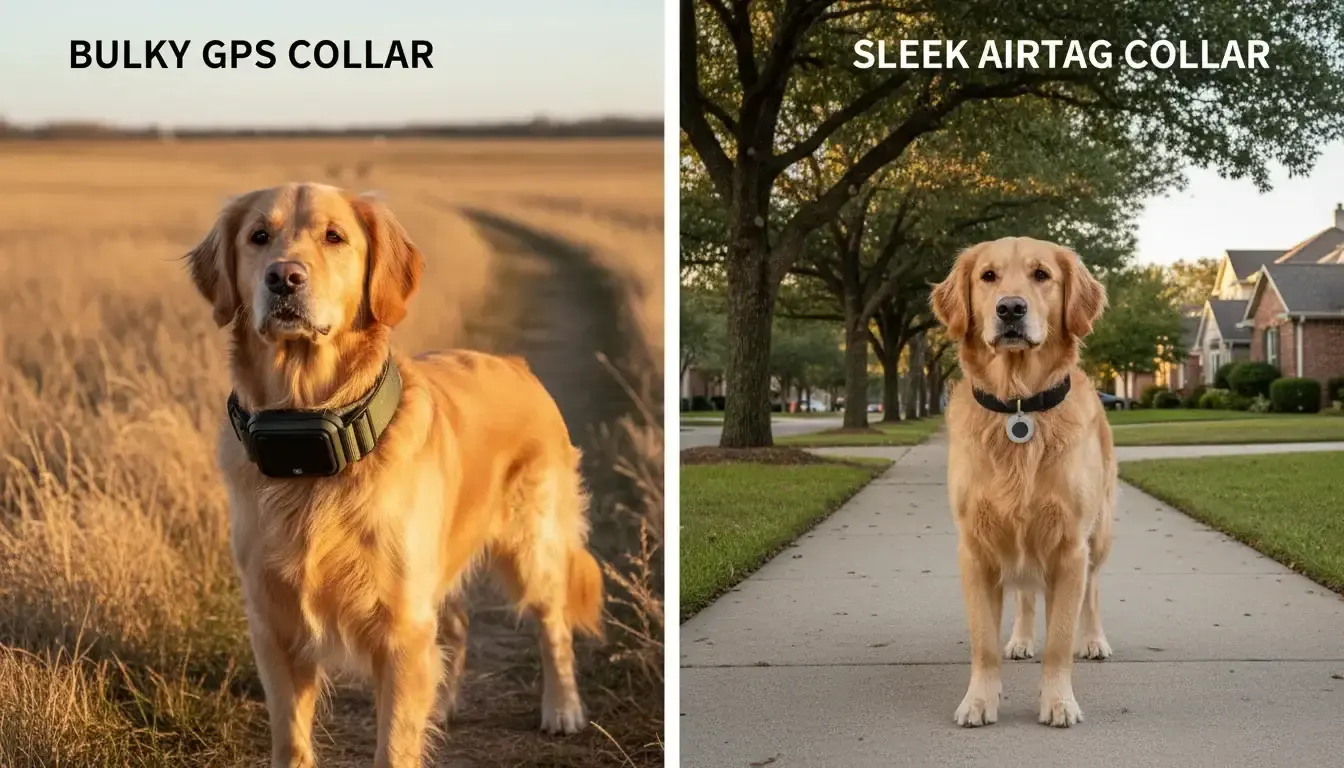
GPS units are often heavier and bulkier.
AirTag is light and works well for everyday wear.
Winner: AirTag for small dogs.
Monthly Commitment
GPS requires a subscription on most brands.
AirTag does not.
Winner: AirTag for simplicity.
Why People Want a No-Subscription Option
A lot of people are not really shopping for "the best tracker." They are trying to avoid three things:
- recurring cost
- charging/app friction
- overbuying for a dog that mostly lives a low-risk neighborhood life
That is why the no-subscription cluster keeps showing up. People want peace of mind without turning a collar into another monthly utility bill.
If that sounds like your situation, the right next read is how much does a GPS dog tracker cost.
Which One If I Refuse Monthly Fees?
If you want the simplest answer, here it is:
- Choose AirTag if your dog is mostly a neighborhood dog, you live around lots of iPhone users, and you want a backup layer that stays simple.
- Choose GPS if your dog is a real escape risk, you are in a rural or low-density area, or you need live location instead of delayed updates.
That does not mean AirTag replaces GPS. It does not.
It means AirTag is often the better answer when your real question is, "What can I put on my dog without signing up for another subscription?"
For a full product-style breakdown of that lane, read dog tracker without subscription.
What About the Collar Itself?
The tracker is only half the equation. The collar matters just as much.
A GPS collar is usually a single unit: the tracker is built into the collar.
An AirTag setup requires two things: the AirTag and a collar that holds it securely. That collar should:
- keep the AirTag from slipping or bouncing off
- stay comfortable for daily wear
- fit your dog properly
- hold up during running, playing, and weather exposure
The Doggo Guard AirTag Collar was built for that use case. The holder is integrated into the collar instead of added as an afterthought.
The Cost Over 3 and 5 Years
Here is an illustrative example using mid-range assumptions.
Assumptions:
- GPS device: $150
- GPS subscription: $10 per month
- AirTag: $29
- AirTag collar: $35
- AirTag battery: about $2 per year
3-Year Ownership
| Option | Cost |
|---|---|
| GPS collar + subscription | $510 |
| AirTag collar setup | $70 |
5-Year Ownership
| Option | Cost |
|---|---|
| GPS collar + subscription | $750 |
| AirTag collar setup | $74 |
That is the heart of the no-subscription argument. The gap is not small. For many owners, the monthly fee changes the decision more than the hardware does.
The Honest Weaknesses
GPS Collar Weaknesses
- The subscription never really goes away.
- The battery has to be managed.
- It can be bulky on smaller dogs.
- It can be more technology than many neighborhood dogs actually need.
AirTag Collar Weaknesses
- It is not GPS.
- It does not give true real-time tracking.
- It depends on other Apple devices nearby.
- The holder has to be secure or the AirTag can fail in motion.
- Anti-stalking alerts can limit usefulness in some theft scenarios.
Choose GPS If:
- your dog lives in a rural or low-density area
- you hike, hunt, or camp with your dog
- your dog is a repeat escape artist
- you need geofencing and live tracking
- you are okay with charging and paying every month
Choose AirTag If:
- you live in a suburban or urban area with lots of iPhone traffic
- you want a no-monthly-fee backup layer
- you want something light enough for daily wear
- you want a simpler "set it and forget it" setup
- you mainly need coverage for the most likely escape scenario: the short neighborhood slip-out
Choose Both If:
- you want an everyday backup plus a live-tracking option for trips
- you use GPS for adventures and AirTag for normal wear
- you want the broadest coverage possible
The Middle Ground: Use the Right Tool for the Right Risk
A lot of owners do not need a permanent GPS plan.
A practical setup looks like this:
- everyday life: AirTag collar
- higher-risk outings: GPS tracker
That gives you a low-friction daily backup without paying for live tracking when you do not need it.
If you want the larger cost and feature comparison, start with how much does a GPS dog tracker cost and then compare it to do AirTags work for dogs.
Frequently Asked Questions
Is Tractive better than AirTag?
Tractive is better if you need a live GPS collar with wider search utility. AirTag is better if you want a cheaper, simpler backup layer with no monthly fee.
Is Fi collar better than AirTag?
Fi is better if you want another live GPS option. AirTag is better if your dog mostly needs a low-friction backup for normal neighborhood life.
Should I compare Tractive vs Fi dog GPS instead of AirTag?
Yes, if your decision is between two subscription GPS collars. In that case, read Tractive vs Fi dog GPS first.
Can I use an AirTag collar and a GPS collar at the same time?
Yes. Some owners use AirTag daily and add GPS for trips or higher-risk situations.
Which is better for a dog that has never escaped?
For a low-risk neighborhood dog, AirTag is usually the simpler answer. It gives you a backup without adding a monthly fee.
What if my dog escapes at night?
GPS usually has the edge because it does not depend on other phones passing by. AirTag can still work, but updates may be slower.
Do I need cell service on my phone to use a GPS collar?
You need some way for the collar's data to reach your phone app, which is why cellular coverage matters.
Will an AirTag work in my neighborhood?
If you live in a dense suburban or urban area, it often will. In low-density areas, the answer gets less reliable.
The Bottom Line
GPS collars are the premium option. They work in more places, update in real time, and are better for high-risk dogs. But they cost more and require ongoing management.
AirTag collars are the simpler option. They cost much less over time, need no monthly fee, and can be a smart backup layer for everyday neighborhood dogs. But they are not GPS and they are not the right answer everywhere.
If you want the no-subscription route, AirTag is usually the first place to start. If you need live pursuit and wide-area coverage, pay for GPS on purpose.
The best choice is the one that matches your dog's risk level and your own willingness to keep paying for it.
If you want a no-fee backup layer for everyday wear, the Doggo Guard AirTag Collar is designed to hold the AirTag securely without turning the setup into another subscription. If you are comparing the active-track lane against microchip-only recovery, read why microchips don't help in real time.
Editorial Notes
How this guide was prepared
This article was prepared to help owners take the next practical step quickly. We combine shelter and veterinary guidance, tracking documentation, and recovery planning so the advice stays useful in a real-world situation.
Written by
Find My Doggo Team
Reviewed by
Find My Doggo Safety Team
Editorial review team
Updated
2026-06-08