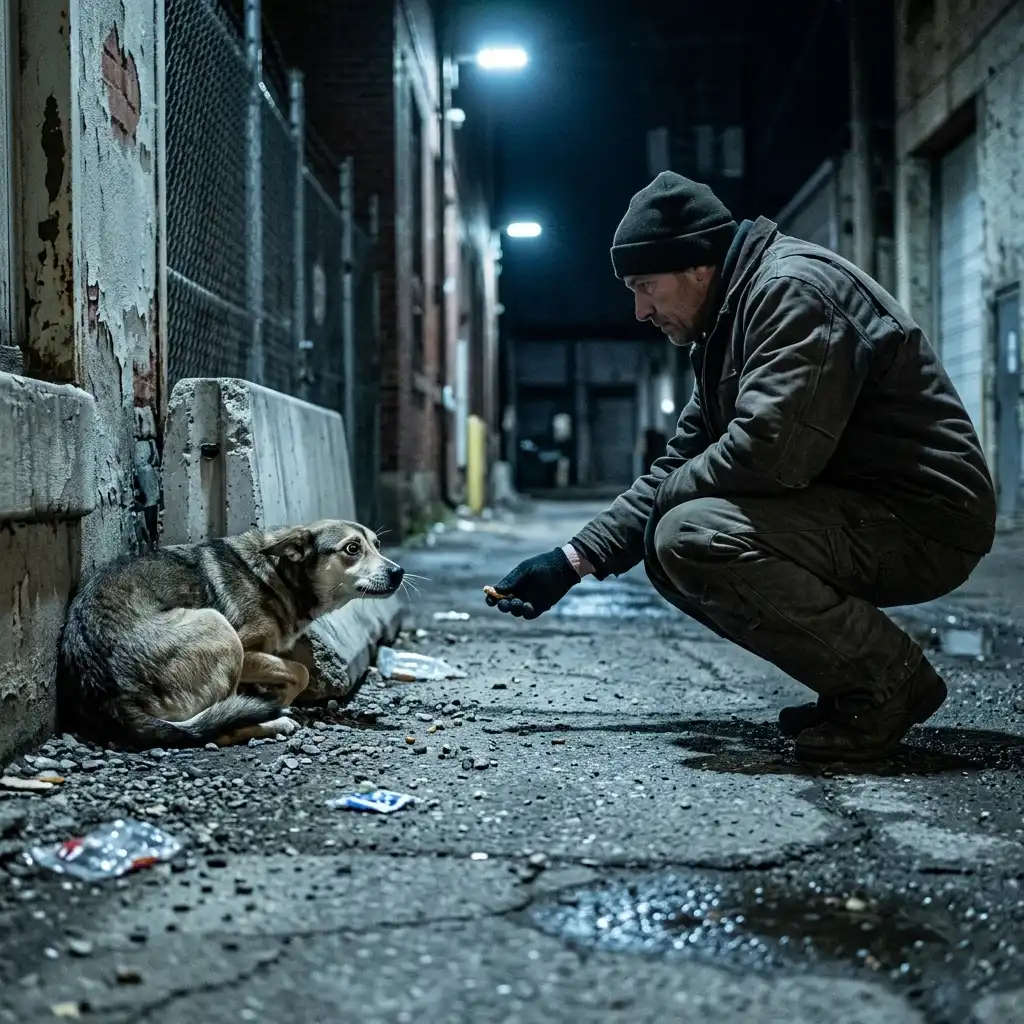
You finally spot the dog. Your heart leaps. You crouch down, slap your thighs, and call their name with excitement.
The dog freezes. Hair rises on their spine. They flash their teeth, growl, and back away.
Your brain can't process it. Why don't they recognize you?
Because a dog lost for more than 48 hours is no longer operating as a domesticated pet. They've crossed into survival mode - and every human approaching them is processed as a predator.
Here's how to safely approach and capture a frightened dog.
Step 1: Eliminate Predator Signals
Everything humans naturally do to show affection reads as a threat to a terrified dog.
Stop immediately:
- Don't walk directly toward them
- Don't make intense eye contact
- Don't tower over them
- Don't reach your hand out for them to sniff
Do this instead:
- Drop your level - sit flat on the ground
- Turn your body sideways (not squared up)
- Look away - focus on the grass or your shoes
You need to communicate: "I have absolutely zero interest in you." This drops the immediate threat level.
Step 2: Use Canine Calming Signals
Dogs communicate stress and peace through subtle body language. You need to speak their language.
While sitting still:
- Yawn slowly and deeply. In the canine world, yawning in a tense situation signals "I am not aggressive."
- Lick your lips gently.
- Blink slowly and avert your gaze.
These signals tell the dog you're not a threat. It takes time, but you'll see their body language start to shift.
Step 3: The Food Trail (Hansel and Gretel Method)
You can't force a frightened dog to come to you. You need to make them decide to cross the distance on their terms.
- Take high-value, powerfully scented food - hot dogs cut into cubes, bacon, liverwurst
- Toss a piece halfway between you and the dog
- Don't look at them while they eat it
- Toss the next piece slightly closer
- Build a slow trail leading to your position
Let the dog dictate the pace. If it takes 20 minutes for them to creep forward four feet, you sit for 20 minutes.
Step 4: The Final Capture
When the dog is eating food from the ground near your legs, you need to execute the capture.
Don't reach over their head to grab their scruff. This triggers an instant bite reflex.
Use a slip lead - a leash that functions as an adjustable loop. Don't fumble with a standard clip on a panicked dog.
As they're focused on eating, slowly raise the slip lead and slide the loop over their head. Once it clears their ears, tighten it firmly but calmly.
The moment the lead tightens, most dogs snap out of survival mode and default back to "leash training" mode. The panic drops.
Prevention Trumps Recovery
Sitting in the cold tossing hot dogs at a terrified animal is the reality of lost dog recovery. You control nothing. You're at the mercy of the dog's fractured psychology.
This is exactly why high-agency owners equip their dog with active tracking before the escape happens. An AirTag in a secure collar means you check your phone, drive to the ping, and retrieve them - no food traps, no feral shift, no hours of waiting.
Bring them home safely. Then upgrade the hardware so you never have to do this again.
Editorial Notes
How this guide was prepared
This article was prepared to help owners take the next practical step quickly. We combine shelter and veterinary guidance, tracking documentation, and recovery planning so the advice stays useful in a real-world situation.
Written by
Find My Doggo Team
Reviewed by
Find My Doggo Safety Team
Editorial review team
Updated
2026-05-14