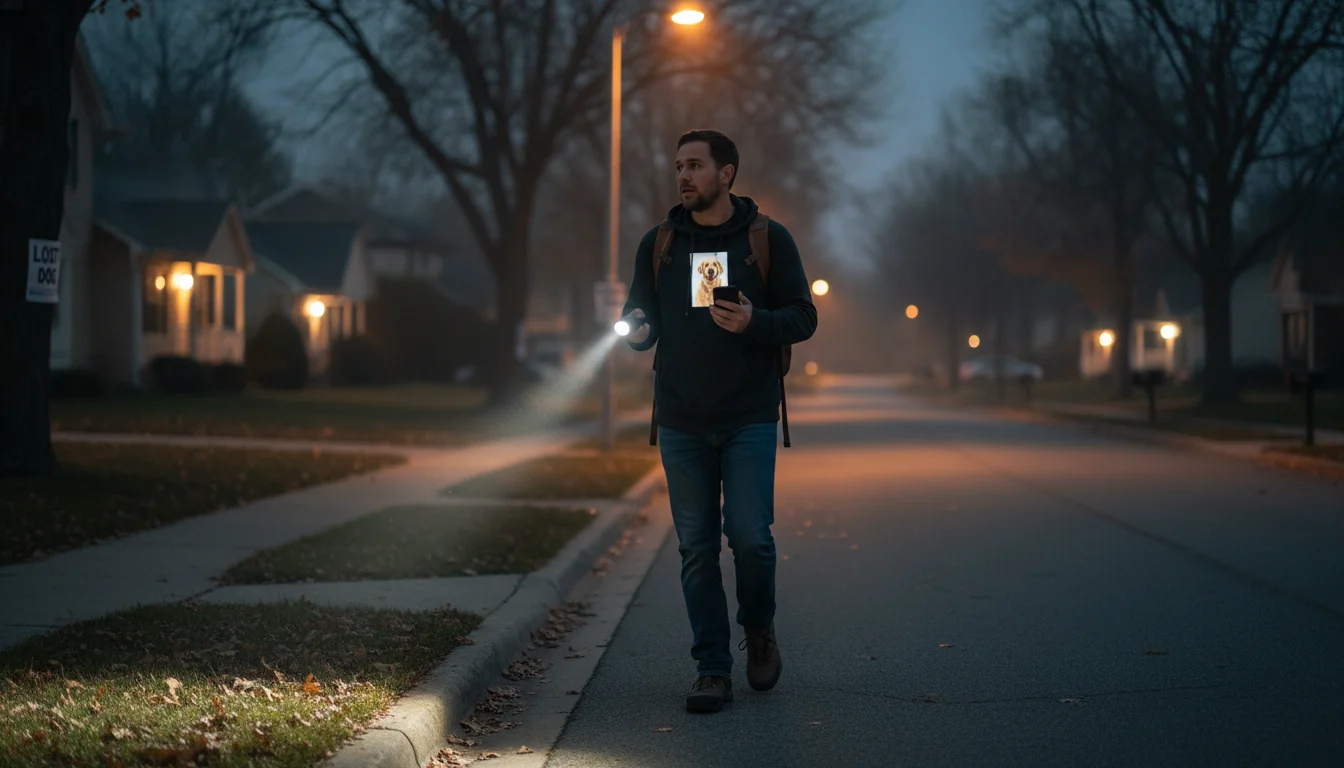
TL;DR
- Start searching immediately. Do not wait to see if they come back. Most lost dogs are found within the first 2 hours and the first 1 mile.
- Call your microchip company within the first 10 minutes. This is the single highest-impact call you can make.
- Search on foot and by car in expanding circles, starting from the escape point. Bring the dog's favorite toy or treat bag.
- Post on local lost dog Facebook groups and Nextdoor within the first hour. These platforms have the fastest community reach.
- Contact local shelters and vets by phone, not just online. Shelter websites are often outdated.
The First 10 Minutes: What to Do Right Now
Your dog just got out. Your heart is pounding. This is the exact order of operations.
Step 1: Call Out and Search the Immediate Area
Most lost dogs do not go far in the first few minutes. They are often within a few hundred yards, confused and looking for you. Call their name. Bring a treat bag and shake it. Walk the immediate area calmly. Panicked shouting can actually scare a nervous dog further away.
Step 2: Call Your Microchip Company
If your dog is microchipped, call the chip company and report them missing. This takes 2 minutes and ensures that if someone finds your dog and takes it to a vet or shelter, the chip will flag as lost. This is the single most important phone call in the first 10 minutes.
Step 3: Text or Call Two People
You need help searching. Text two people right now. Give them the location, the dog's name, a photo, and what they are wearing (collar color, harness, etc.). Do not spend 20 minutes making flyers before you have help in the field.
Step 4: Get in Your Car
If the dog is not found within 10 to 15 minutes of searching on foot, get in your car. Drive the surrounding streets slowly. Call their name at stop signs. Most dogs that travel by car end up within a 1 to 2 mile radius of the escape point in the first hour.
The First Hour: Expand the Search
If your dog is not back within the first hour, the search changes from immediate response to organized effort.
Post on Social Media Immediately
The fastest way to get eyes on your dog is local social media. Post in this order:
- Local lost dog Facebook groups (search "[your city] lost dogs" on Facebook)
- Nextdoor (hyperlocal neighborhood network)
- Ring Neighbors app (if you have Ring doorbells in your area)
- Instagram and X with local hashtags
Your post should include:
- A clear, recent photo of your dog
- The dog's name, breed, size, and color
- The exact location and time they went missing
- Whether the dog is microchipped
- Your phone number
- Whether the dog is friendly or fearful of strangers
Call Local Shelters and Vets
Do not rely on shelter websites. Call them directly. Describe your dog. Give them your number. Shelters are often understaffed and may not have time to cross-reference online listings. A phone call puts a human on the other end who can watch for your dog.
Set Up a Scent Trail
If you have a recently worn shirt or the dog's bedding, place it outside your front door. The familiar scent can help guide a disoriented dog back home. Some owners also place the dog's litter box or crate outside, though this is more common for cats.
Hours 1 to 6: Organized Search
Create and Distribute Flyers
Print 50 to 100 flyers. Keep the design simple: large photo, "LOST DOG" in big letters, breed, color, last seen location, and your phone number. Post them at:
- Intersections near the escape point
- Vet offices and pet stores
- Coffee shops and community bulletin boards
- Dog parks and walking trails
- Mailboxes (with permission) near your home
Search in Expanding Circles
Lost dogs tend to move in one of three patterns:
- Circling back. Many dogs try to return home. They may circle the area, cross roads, and approach from an unexpected direction.
- Running in a straight line. Fear-driven dogs often run in one direction for a distance, then stop and hide.
- Hiding nearby. Some dogs, especially shy or anxious ones, hide under porches, in bushes, or in garages within a few hundred yards of home.
Cover all three patterns. Search on foot in a 1-mile radius. Drive the roads in a 2-mile radius. Ask neighbors to check their yards, garages, and sheds.
Use Technology
If your dog has a GPS tracker, activate it now. If they are wearing an AirTag, open the Find My app and check for recent pings. Even a last-known location narrows your search area significantly.
Hours 6 to 24: Widen the Net
Contact Animal Control
File a lost dog report with your local animal control agency. Give them your flyer. Ask them to call you if a matching dog is brought in. Follow up the next morning.
Expand Social Media
Share your original post again with an update. Ask friends to share it. The more shares, the wider the geographic reach. Some lost dog Facebook groups have tens of thousands of members across entire metro areas.
Search at Dawn and Dusk
Dogs are most active at dawn and dusk. These are the best times to search, especially for dogs that are hiding during the day. Bring a flashlight and call quietly. A hiding dog may not respond to loud calling but may come to a calm, familiar voice.
Do Not Give Up
Most lost dogs are found within 24 to 48 hours. The ASPCA reports that the majority of lost pets are recovered within the first 24 hours, usually within a mile of where they escaped. Keep searching. Keep calling. Keep posting.
What NOT to Do
Do Not Chase
If you spot your dog and they are loose, do not chase them. Chasing triggers a prey drive or fear response and will make them run faster. Instead, stop, turn sideways (non-threatening body language), call their name calmly, and crouch down. Toss treats toward them. Let them come to you.
Do Not Assume They Will Come Back on Their Own
Some dogs do return on their own. Many do not. Waiting to see if they come back is the most common mistake owners make. Start searching immediately. You can always stop searching when the dog is home.
Do Not Rely Only on One Method
Flyers alone are not enough. Social media alone is not enough. Calling shelters alone is not enough. The owners who find their dogs fastest use every channel simultaneously.
Do Not Blame Yourself
This is not the time for guilt. Dogs escape. It happens to the best owners with the best fences. Focus your energy on the search. You can evaluate prevention after your dog is home.
How Dogs Get Found: The Real Numbers
Based on data from shelters and lost pet recovery organizations:
- Most lost dogs (roughly 70-80%) are found within the first 24 hours.
- The majority are found within 1 to 2 miles of the escape point.
- Microchipped dogs are significantly more likely to be returned to their owners than non-microchipped dogs.
- Social media posts in local groups are now the #1 way dogs are found, ahead of shelter visits and flyers.
- Dogs found by strangers (not the owner) are usually recovered because someone checked the microchip or saw a social media post.
After You Find Your Dog
When your dog is back home, take these steps before anything else:
- Check for injuries. Even if they look fine, a vet visit is wise. Dogs hit by cars may have internal injuries that are not obvious.
- Update your microchip status from "lost" to "found/reunited."
- Take down your posts and thank the community. Let everyone know the dog is home.
- Figure out how they got out. Check the fence, the gate, the door. Fix the gap.
- Consider a backup tracking plan. Whether it is a GPS tracker for high-risk dogs or an AirTag collar for everyday peace of mind, the best time to add a tracking layer is right now, while the scare is fresh.
The Backup Plan You Hope You Never Need
The worst time to think about tracking is after your dog is gone. The best time is right now, while everything is calm.
A microchip is the foundation. It is permanent and does not run out of battery. But it only helps after someone finds and scans your dog.
For real-time awareness during an active search, you need something that broadcasts location. A GPS tracker works anywhere with cell service. An AirTag collar works in any area with iPhones nearby, which includes most suburban and urban neighborhoods.
The Doggo Guard AirTag Collar was built for exactly this: a simple, always-on backup layer that works with the iPhone you already carry. No monthly fee. No charging routine. Just a secure holder for your AirTag, on a collar your dog wears every day.
Because the moment your dog slips out, you do not want to be starting from zero.
If your dog is missing right now: start searching, call your microchip company, post on local Facebook groups, and do not wait. Every minute matters. If you have recovered your dog and want to prevent the next scare, explore the Dog Safety Center for prevention guides and tracking comparisons.
Editorial Notes
How this guide was prepared
This article was prepared to help owners take the next practical step quickly. We combine shelter and veterinary guidance, tracking documentation, and recovery planning so the advice stays useful in a real-world situation.
Written by
Find My Doggo Team
Reviewed by
Find My Doggo Safety Team
Editorial review team
Updated
2026-05-14